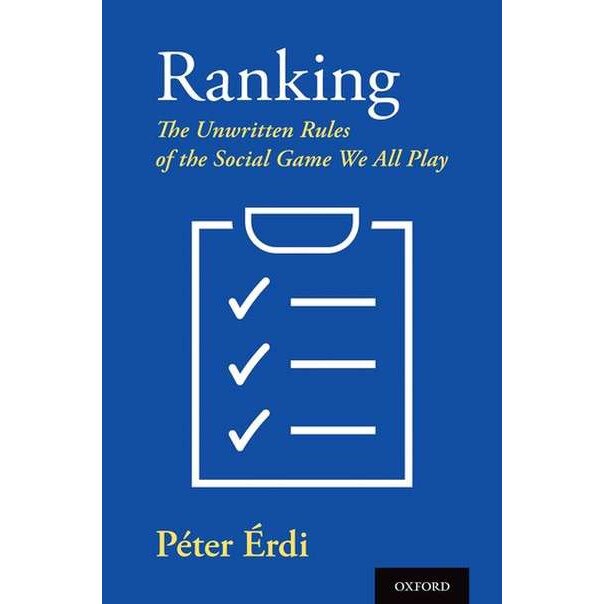
Human beings are competitive. We want to know who is the strongest, who is the richest, and who is the cleverest of all. Some situations, like ranking people based on height, can be ranked in objective ways. However, many "Top Ten" lists are based on subjective categorization and give only the illusion of objectivity. In fact, we don't always want to be seen objectively since we don't mind having a better image or rank than deserved. Ranking: The Unwritten Rulesof the Social Game We All Play applies scientific theories to everyday experience by raising and answering questions like: Are college ranking lists objective? How do we rank and rate countries based on their fragility, level of corruption, or even happiness? How do we find the most relevant web pages?How are employees ranked? This book is for people who have a neighbor with a fancier car; employees, who are being ranked by their supervisors; managers, who are involved in ranking but may have qualms about the process; businesspeople interested in creating better visibility for their companies; scientists, writers, artists, and other competitors who would like to see themselves at the top of a success list; or college students who are just preparing to enter a new phase of social n/a will engage in an intellectual adventure to better understand the difficulties of navigating between objectivity and subjectivity and to better identify and modify their place in real and virtual communities by combining human and computational n/a editions available in German, Korean, Japanese, Complex Chinese, and Simplified n/a beings are competitive. We want to know who is the strongest, who is the richest, and who is the cleverest of all. Some situations, like ranking people based on height, can be ranked in objective ways. However, many Top Ten lists are based on subjective categorization and give only the
illusion of objectivity. In fact, we don't always want to be seen objectively since we don't mind having a better image or rank than deserved.
Ranking: The Unwritten Rules of the Social Game We All Play applies scientific theories to everyday experience by raising and answering questions like: Are
college ranking lists objective? How do we rank and rate countries based on their fragility, level of corruption, or even happiness? How do we find the most relevant web pages? How are employees ranked? This book is for people who have a neighbor with a fancier car; employees, who are being ranked by their supervisors; managers, who are involved in ranking but may have qualms about the process; businesspeople interested in creating better visibility for their companies; scientists, writers,
artists, and other competitors who would like to see themselves at the top of a success list; or college students who are just preparing to enter a new phase of social competition. Readers will engage in an intellectual adventure to better understand the difficulties of navigating between
objectivity and subjectivity and to better identify and modify their place in real and virtual communities by combining human and computational intelligence.
Translation editions available in German, Korean, Japanese, Complex Chinese, and Simplified Chinese.Recenzii
"An informative and amusing book. The author collected a treasury of stories and reflections connected with comparison, rating and ranking from the widest possible area of sports, arts, sciences, politics, media and shopping, just to mention a few. The book's main concern is not how to rank, but rather how and in what extent ranking can be avoided.""Peter Érdi's book was not a risk-free venture. It deserves a lot of success, since it has a large literary immersion, but does not hide the opinions of others.""Rankings are essential in our lives-they determine the education we receive, the jobs we qualify for, the books we read, and the music we listen to. In Ranking, Peter Érdi's vivid prose brings us the science of rankings. Using examples from politics to culture, he shows how these patterns determine who wins and who loses the ranking game.""Most parents know their children are above average-sure proof of the subjectivity of ratings. With a light touch, combining personal experience, findings from biology and sociology and more, and with witty asides, Peter Érdi explains why Top 10 Lists fascinate us, and how to temper subjectivity with hard data when ratings and rankings truly matter.""As my grandmother used to say, if your actions are based on comparisons with others, you'll never enjoy life. But as Ranking shows — with lucid examples from practically every sphere of human endeavor — we humans can't help but compare ourselves to others. So who's the best at revealing the principles and mechanisms that underpin the ubiquitous tendency to compare? The pantomathic Peter Érdi, that's who! Érdi's book, written with insight and humor,is a delightful read. I learned a lot from it, as will any individual or organization interested in this enduring aspect of the human condition-in comparing better and choosing wisely.""Drawing upon a remarkable range of disciplines, field studies, and historical insights, Érdi expertly reveals the hidden social and cognitive dynamics that inform our never-ending hunger to assign metrics to social life. With great nuance and a keen eye for detail, Érdi takes us through how supposedly straightforward processes of measurement, comparison, prioritization, and reputation management are fraught with bias and complex hidden social n/a is an analytical tour-de-force and a joy to read, going straight to the top of my list of indispensable works on social hierarchy."
Nota biografica
Dr. Érdi serves as the Henry R. Luce Professor of Complex Systems Studies at Kalamazoo College. He is also a research professor in his home town, in Budapest, at the Wigner Research Centre of Physics of the Hungarian Academy of Sciences. In addition, he is the founding co-director of the Budapest Semester in Cognitive Science, a study abroad program. Peter is a Member of the Board of Governors of the International Neural Network Society,the past Vice President of Membership of the International Neural Network Society, and the Editor-in-Chief of Cognitive Systems Research.